Tired of paying high property taxes? I just appealed my property tax valuation, so I thought I would share the steps for how to do it. This will only be helpful if you live in Maricopa County, AZ. (And actually our property taxes aren't that high compared to some states, but it's still a good idea to appeal if your valuation is inaccurate.)
There are two ways to appeal, administrative and judicial. I will only be talking about the administrative option. (For the judicial, according to the State Board of Equalization, "You may file a petition directly with the Tax Court at any time after receiving the Notice of Value, provided you do not file an administrative appeal - but you must file it no later than December 15. This is the Judicial Process.")
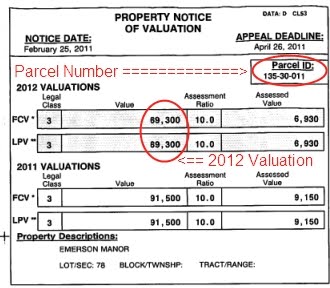
If you hurry, there is still time to appeal your 2012 valuation, which was the one that you should have received recently. The county sends out a postcard in February with your valuation for the following year, which looks about like this:
The deadline for them to send out the postcard is March 1, and then the deadline for you to appeal is 60 days later. So you probably only have another week or so. Get on it!
If you did not receive a postcard, you can see your valuation info online:
- Go to the assessor's website
- Enter your street number and name (or your parcel number if you know it)
- You will be taken to your property info page.
- Scroll down to "Valuation Information"
How is the amount of tax determined?
The way the taxes are calculated is quite a complicated mess. It's not imperative that you understand the details of how the taxes are calculated, and I don't really understand it completely myself, so feel free to skip down to the section below about appealing. But here are some basics.
One important thing to understand is that when your assessed valuation goes down from one year to the next, that does not necessarily mean your taxes go down! Your assessed value only determines how much of the pie is your responsibility. So if everyone's valuation went down about the same percentage, then the percentage of the taxes that are your responsibility, or your piece of the pie, would not change.
Your property is identified by a unique parcel number. You will see on your notice of valuation a "full cash value" (FCV) and a "limited property value" (LPV), which are each used to determine different portions of the tax for your parcel. Then there's an assessment ratio which is multiplied by the FCV and LPV to determine the value that they then multiply by some arbitrary "tax rate" to determine your actual amount of tax. You can read more nitty gritty details in the FAQs here.
For owner occupied homes and rental homes, the assessment ratio is always 10%. (It's higher for land and commercial properties.) So if your full cash value was $100,000, then your assessed value would be $100,000 x 10% = $10,000. And if the tax rate was 8%, then your annual property taxes owed would be $10,000 (assessed value) x 8% (tax rate) = $800.
If you are interested in seeing a breakdown of where your taxes are going:
- Go back to the assessor's website
- Enter your street number and name (or your parcel number)
- You will be taken to your property info page.
- Click on "View Tax Information"
- You will be taken to the treasurer's website.
- Click on "Tax Bill" in the upper left hand corner.
- Scroll down and you can see all the places your property taxes are being used for. (The majority goes to the school districts.)
Is My Property Valuation Too High?
If you want to appeal your tax valuation, you will need to show that the valuation should have been lower. (At least I'm assuming you want your taxes lowered, not increased.) There are at least 4 ways you can value your property:
- Market approach
- Cost approach
- Income approach
- "Equity" approach
Market approach. Using the market approach just means looking at the current market value of your home. So for example if the valuation on your property notice was $100,000 and the comparable sales in your neighborhood show that your home is worth $80,000, then you could argue that your home is worth $80,000, by providing those comps.
Cost approach. Using the cost approach means looking at how much it would cost to build your home. So for example if the valuation on your property notice was $100,000 and you know that it would only cost $80,000 to build your home, then you could argue that your home is worth $80,000, by showing that it would only cost $80,000 to build it (including the purchase of the land). This option is not going to be helpful anytime soon, since the assessments are generally far lower than the cost to build.
Income approach. Using the income approach means looking at how much your property is worth based on how much income it brings it. This would only apply for income (rental) properties.
"Equity" approach. This last one, which I am calling the "equity" approach, just means looking at how much the other properties in your neighborhood were assessed for, and seeing if theirs were assessed for less than yours. If the other similar sized properties in your area were assessed for less than yours, then you have a strong argument that yours should also be assessed for less. So, even if you think the assessed value of your property is equal to or less than current market value, you should still check and make sure that it's also in line with the amounts that your neighbors' properties were assessed for. Otherwise you'll have to pay for more than your share of the pie!
How To Check On The Assessed Values Of The Properties In Your Area
To check on the assessed values of the properties in your area:
- Go to the Assessor's website.
- Scroll over "Maps" and click on "GIS Interactive Maps"
- In the search fields on the right, enter the Street number and Street name (or parcel number) for your property, and click "Submit".
- Your parcel will be highlighted.
- On the right, click on the "Valuation Data" tab to see the assessed value, and click on the "Property Data" tab to see the size of your home. (Make sure the square footage is correct. If the assessor has an incorrect value for your home size, that is another factor that you could appeal.)
- On the map, click on the neighboring lots on your street and in your area. After clicking on each parcel, click on the "Property Data" tab to check the size of the home.
When you find properties similar in size to yours, click on the "Valuation Data" tab and compare their valuations to yours.
- If your neighbors with similar sized properties have lower valuations than yours, then you have cause for appeal. You're paying for too much pie! Make a note of the parcel numbers and valuations that support your case.
Appealing the tax valuation
If you decided based on any of the approaches above that you can argue that your home should have a lower valuation, then you can appeal the valuation. To appeal, go to
this page on the Assessor's website, enter your parcel number, click "Submit", and then follow the instructions on the form to make your case!
(If you are confident in your case, click on "Yes" for question 8, "CHECK HERE TO REQUEST A MEETING WITH THE ASSESSOR'S OFFICE". According to David Schweikert, former Maricopa County Treasurer, that will help your chances.)
After your appeal, the assessor must consider, decide, and answer your request on or before August 15. If you do not agree with the decision, you can file a petition with the Board of Equalization for the county.
Good luck!